
Real Estate Funnels in GoHighLevel: Never Let a Hot Lead Go Cold
In real estate, the lead you answer in five minutes and the lead you answer in five hours might as well be two different leads. A buyer who just clicked on a listing is, at that exact moment, also looking at three other agents' listings. A seller who just requested a home valuation is filling out a form on a second website while your notification sits unread.
Most agents and teams don't lose these deals because they're bad at selling houses. They lose them in the gap between "lead came in" and "someone responded" — and then again in the months between "not ready yet" and "ready now," when nobody stayed in touch. This guide shows how a real estate funnel in GoHighLevel closes both gaps: instant response for every new lead, and patient, automatic nurture for everyone who isn't ready today.
Where Real Estate Leads Actually Come From
Before the funnel, it helps to see the full picture, because most teams have more lead sources than they realise:
Portal and listing sites — enquiries from property portals and your own listing pages
Your website and landing pages — home valuation requests, buyer guides, neighbourhood reports
Social media ads — Facebook and Instagram campaigns for a listing or a lead magnet
Google searches and your business profile — calls and direction requests from people ready to talk
Past clients and referrals — the highest-quality source, and the one most teams follow up with least systematically
Open houses and sign calls — captured on paper, if at all.
Every one of these can feed the same system. The funnel's first job is simply this: no matter where a lead comes from, it lands in one CRM, in one pipeline, and triggers the same instant response.
Step 1: One Funnel Per Intent
A buyer, a seller, and an investor are three different conversations, and they should not land on the same generic contact form. In GoHighLevel, build a simple funnel for each intent:
Seller funnel: a home valuation page — address first, then contact details — followed by a thank-you page that sets expectations ("Your valuation is being prepared; watch for a text from us shortly").
Buyer funnel: a lead magnet or listing-alerts page — a neighbourhood guide, new-listing alerts, or a featured property — in exchange for name, phone, and email.
Open house funnel: a registration page that captures visitors before the event instead of relying on a paper sign-in sheet nobody can read afterwards.
Each funnel tags the contact by intent and drops them into the right pipeline stage. That tagging is what makes every later automation personal instead of generic — sellers get seller messages, buyers get buyer messages.
Step 2: Speed to Lead — The First Sixty Seconds
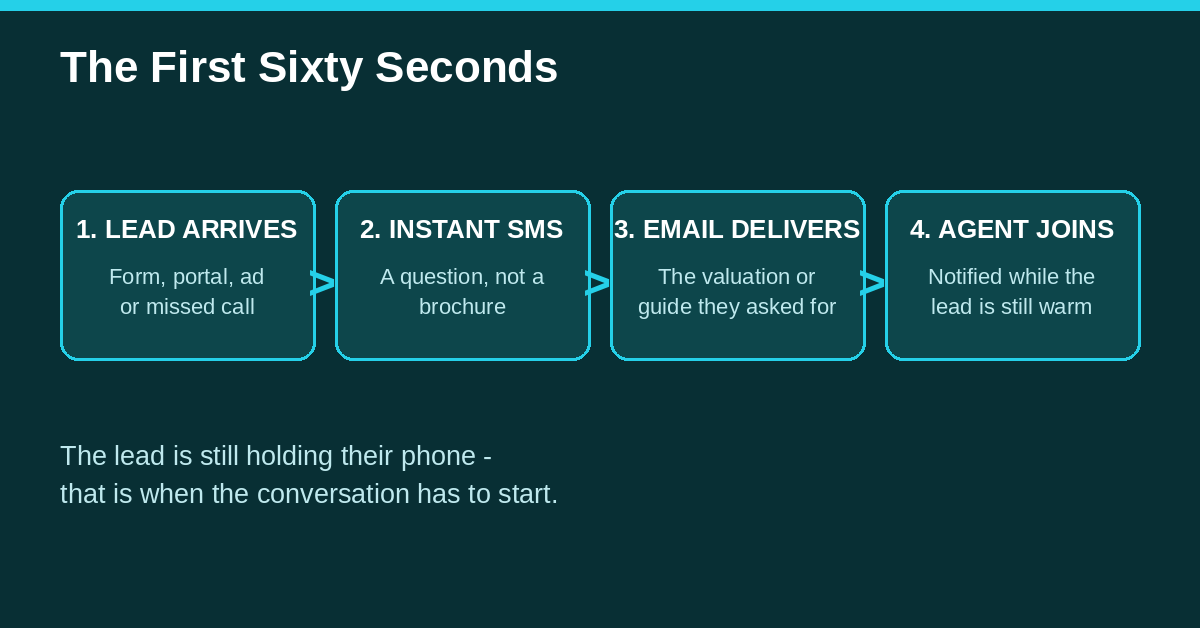
This is the highest-value automation in the entire system, and it's simple. The moment any form is submitted, a call is missed, or a portal lead arrives, GoHighLevel fires:
An instant SMS (within seconds): "Hi [Name], thanks for your interest in [listing/valuation]. When's a good time for a quick call?" — a question, not a brochure, because questions get replies.
An instant email with the promised item (the valuation, the guide, the listing details) so the lead gets value even if they never reply.
A task and notification for the agent, with the lead's details, so a human joins the conversation while it's still warm.
A short follow-up sequence over the next few days for non-responders — a couple of texts and an email, spaced out, each with one easy next step.
The point isn't to replace the agent. It's to make sure a real conversation starts while the lead still remembers submitting the form. On one real estate platform project, rebuilding the lead capture and follow-up system this way recovered an estimated $25K in previously lost leads — business that had already enquired and simply never been followed up properly. That's the normal size of the leak in a busy team's pipeline.
Step 3: A Pipeline You Can Actually Read
Speed gets the conversation started; the pipeline keeps it from dying quietly. In GoHighLevel, every lead sits in a visual pipeline — New Lead, Contacted, Conversation Started, Appointment Set, Under Contract, Closed, Not Ready — and two rules make it work:
No lead sits still. Automations flag or nudge any opportunity that hasn't moved or been touched in a set number of days, so "I forgot about that one" stops happening.
Every stage change triggers the right thing. Appointment set? Confirmation and reminders go out automatically. Moved to Not Ready? The lead drops into long-term nurture instead of a dead spreadsheet tab.
For a team leader, this is also the first honest view of the business: how many leads came in this month, how many became appointments, and where the rest stopped.
Step 4: Long-Term Nurture — Where Most Commissions Actually Live
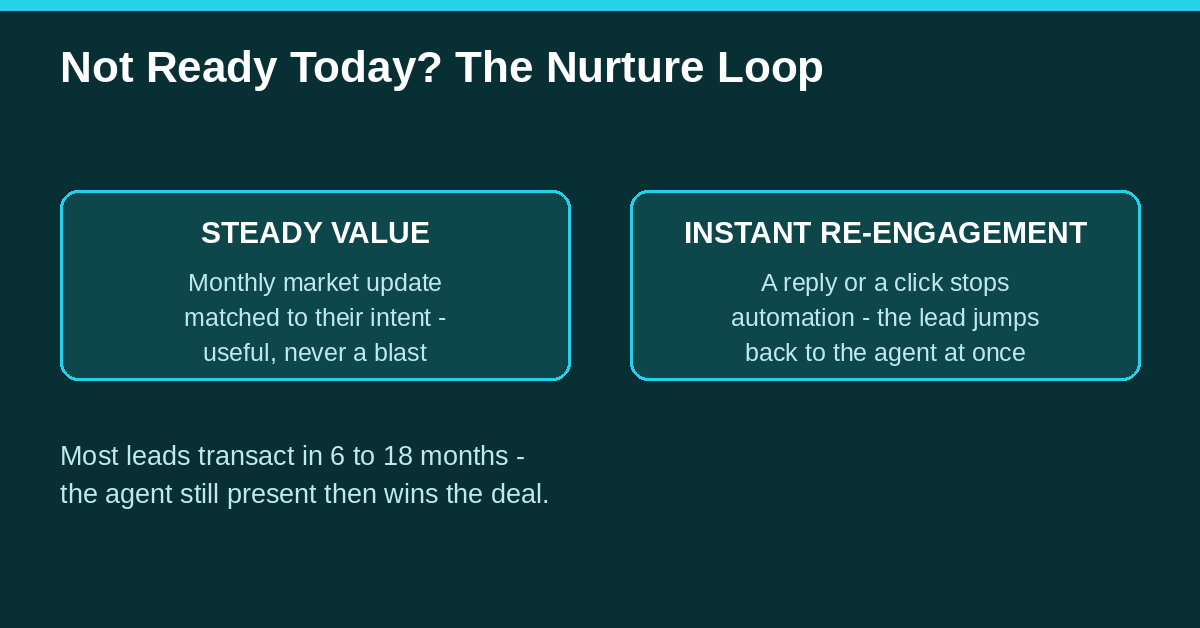
Here's the uncomfortable truth of real estate follow-up: most leads who enquire today will transact in six to eighteen months, if they transact at all. The agent who gets that deal is rarely the one who answered first — it's the one who was still usefully present when "someday" became "now."
Long-term nurture in GoHighLevel is not a monthly blast of "just checking in." It's a light, steady rhythm the lead barely has to think about:
Listing and market updates matched to their intent and area — new listings for buyers, sold prices near their home for sellers.
A monthly email with something genuinely useful: a local market snapshot, a seasonal maintenance tip for sellers, a rate-change explainer for buyers.
Milestone touches — a message on the anniversary of their enquiry or their move — that keep the relationship human.
Instant re-activation: the moment a nurtured lead replies, clicks a listing, or books a call, automation stops and the lead jumps back to the top of the pipeline with the agent notified.
This is also where past clients belong. A past client who gets two useful touches a year is a referral source; one who hears nothing for five years has forgotten your name. If you'd like a specialist to build this properly, this is core work for a GoHighLevel expert who builds for service businesses.
Step 5: Appointments That Actually Happen
When a nurtured or new lead is ready, the funnel's last job is to make booking effortless: a calendar link in every sequence, automatic confirmation, a reminder the day before and an hour before, and a no-show follow-up that reschedules instead of scolding. Show rates climb when the reminder system is boring, consistent, and automatic — which is precisely what software is good at and busy agents are not.
Putting It Together
A real estate funnel system isn't one tool; it's a chain: capture from every source, respond in seconds, track in a pipeline, nurture for months, and make booking effortless when the moment comes. Break any link and leads leak. Build the whole chain in GoHighLevel and it runs the same way on your busiest day as on your quietest.
The funnel and automation services at Funnels by Zayyan cover lead capture, speed-to-lead, and nurture builds for service businesses, and you can Book a free strategy call to find out where your own pipeline is leaking.
FAQ
How fast should a real estate lead really be answered?
Within the first minute is the standard worth aiming for, because the lead is usually still holding their phone and still on your listing. Automation makes that realistic around the clock — including evenings and weekends, when a large share of enquiries arrive.
Can GoHighLevel receive leads from property portals and ad platforms?
Yes. Leads from Facebook and Instagram ads flow in natively, and portal or website leads can be captured through forms, webhooks, or email parsing into the same CRM — so every source lands in one pipeline with the same instant response.
Won't automated texts annoy buyers and sellers?
Generic blasts annoy people; relevant, well-timed messages don't. The rules are simple: respond to what they asked about, keep messages short, space follow-ups out, and stop automated messages the moment a real conversation starts or the lead opts out.
How long should long-term nurture run?
As long as the lead stays subscribed — real estate timelines are measured in months and years, not weeks. A light monthly rhythm plus intent-based updates can run for a year or more at almost no cost, which is exactly why it outperforms the "follow up for a week, then forget them" approach.
I'm a solo agent, not a team. Is this overkill?
It's arguably more valuable solo. A team can brute-force follow-up with people; a solo agent can't be on a showing, at a closing, and answering a new lead at the same time. Automation is what lets one agent respond like a team.


